
Premium Siding and Cedar Shake, Built for the North Shore Coast
James Hardie fiber cement and Western red cedar shake, installed by Clarke's own exterior crew. Two materials, chosen because they are what actually holds up to salt air and New England freeze-thaw. Dave Clarke walks every job himself.
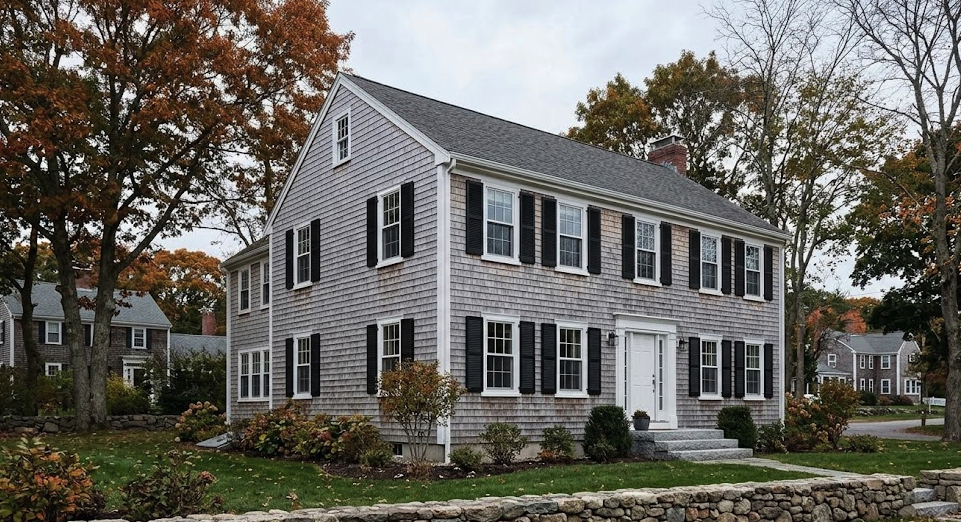
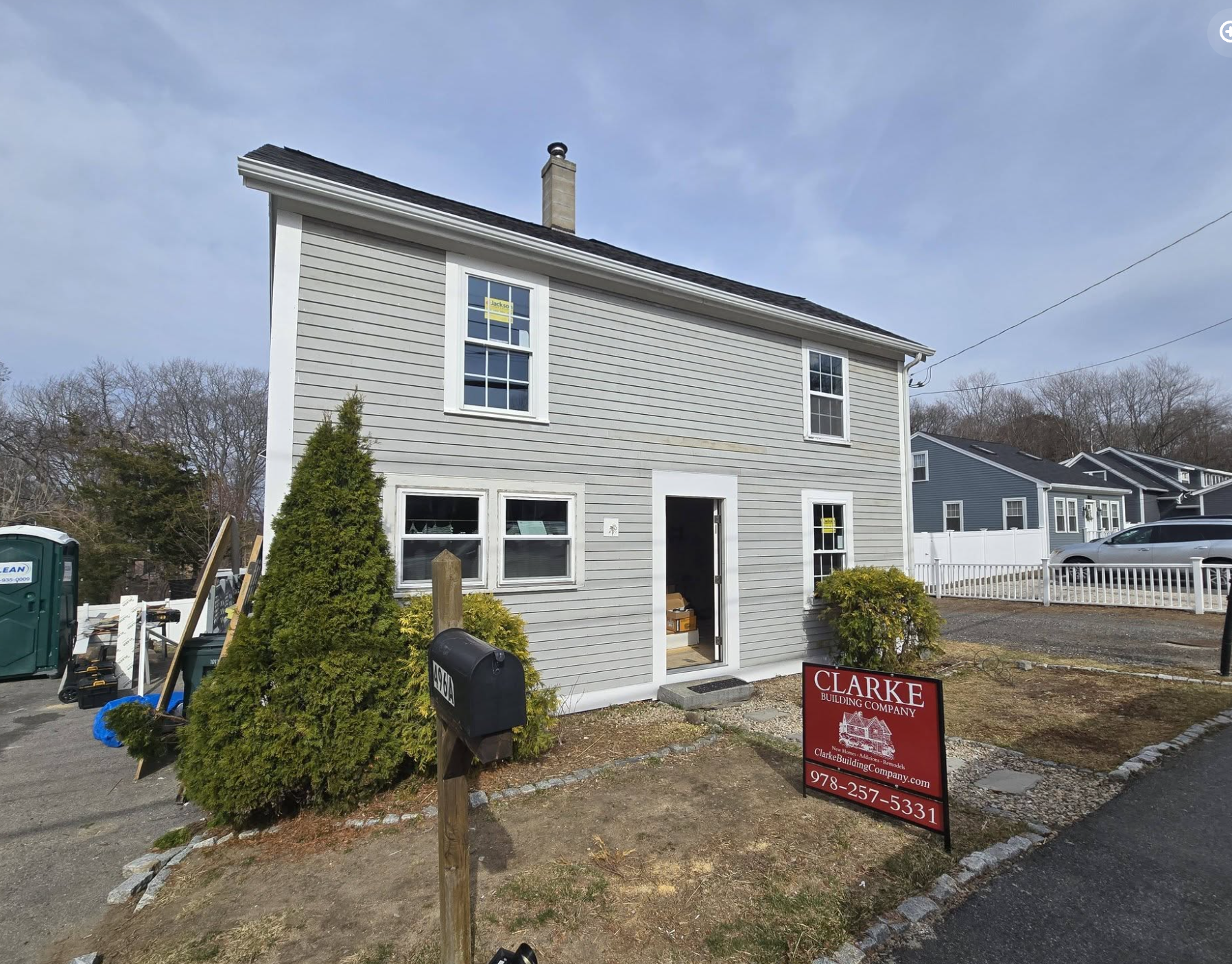
Clarke Building Company installs James Hardie fiber cement and Western red cedar shake siding for homeowners on the Massachusetts North Shore. The company is based in West Newbury and owned by Dave Clarke, who is the single point of contact on every project. Exterior work is performed by Clarke's own crew rather than subcontracted day labor.
- Materials installed
- James Hardie fiber cement (HardieZone HZ5 product line for northern freeze-thaw climates) and Western red cedar shake, in both natural and pre-finished options.
- Also covered
- Exterior trim, porch rebuilds, soffits, fascia, columns and railings. Siding is one part of the exterior; the trim details are what make it read as finished work.
- Installation method
- Cedar courses are set with a back jig rather than snapped to a chalk line, which holds an identical reveal across the whole wall.
- Who does the work
- A ten-person exterior crew led by a lead carpenter, working in Clarke shirts. Dave Clarke prices the job and stays on it through final walkthrough.
- Service area
- West Newbury, Newburyport, Ipswich, Amesbury, Hamilton, Topsfield, Newbury, Georgetown, Boxford, Rowley and Salisbury, Massachusetts.
- Not offered
- Clarke does not market or specialize in vinyl siding, and does not provide in-house architectural design. Clarke builds what your architect or designer draws.
- Contact
- (978) 693-5706 · 51 Pleasant St., West Newbury, MA 01985 · Monday to Friday, 8:00am to 5:00pm.
Why does siding fail early on the North Shore?
Three things get at a wall here. Salt in the air, water that freezes and thaws a hundred times a winter, and wind driving rain sideways into every seam. Materials that do fine in Ohio do not always do fine in Ipswich.
Most of the siding failures we get called about are not really material failures. They are installation failures. Nails driven too tight so the board cannot move. No gap at the trim, so the first hard freeze splits the end. Housewrap lapped the wrong way, sending water behind the wall instead of down it. The siding gets blamed and the wall assembly was the problem.
So Clarke works in two materials, fiber cement and cedar, and installs both the way the manufacturers and the trade actually specify. That is a narrower offer than most exterior companies make. It is deliberate.
One thing to be clear about up front. Clarke is a builder, not a design firm. If you are working with an architect, Dave builds their drawings and coordinates with them directly. If you are not, he can recommend people. He will not sell you a design package you did not ask for.
What makes fiber cement worth the extra cost?
Fiber cement is cement, sand and cellulose fiber. It does not feed insects, it does not rot, and it will not melt. That last one matters more than people expect. Low-E windows reflect concentrated sunlight, and on a hot day that reflection is enough to warp vinyl on a neighboring wall. Fiber cement does not care.
James Hardie makes its northern products under the HardieZone HZ5 designation, engineered for climates that go through repeated freeze-thaw cycles. That is the line we install here. It holds paint longer than wood and it stays dimensionally stable through a New England winter.
The tradeoff is weight and cutting. Fiber cement is heavy, it dulls blades, and cutting it produces silica dust that has to be handled properly. It is a material that rewards a crew that installs it regularly and punishes one that does not.
Cedar shake siding, and why it is still worth doing properly
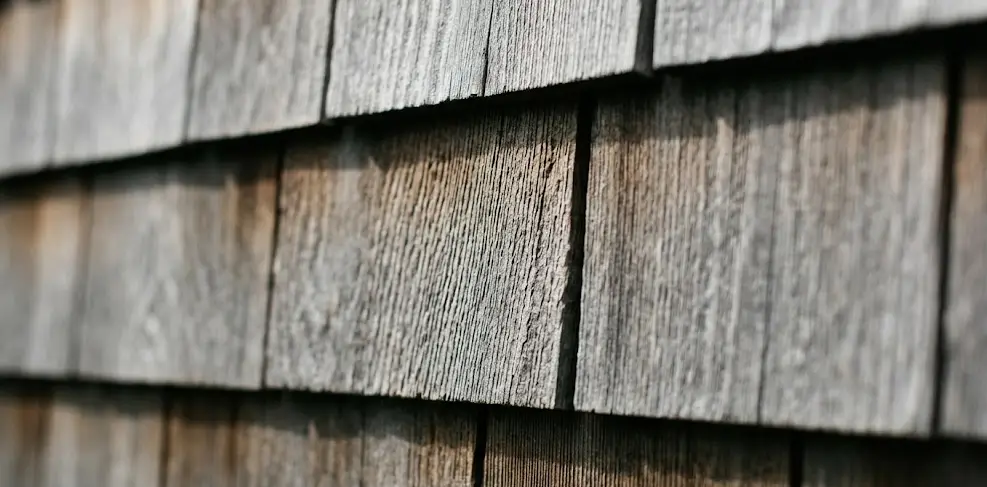
Cedar is the material this coast was built in. On a Newburyport Federal, an Ipswich colonial, or a Cape in Rowley, nothing else looks right. Western red cedar is naturally rot and insect resistant, it takes stain beautifully, and left alone it weathers to the silver-grey you see on every house near the water.
There is a real difference between grades. Hand-split shakes have a rough, irregular face and a deep shadow line. Taper-sawn is smoother and lays flatter. Perfection shingles give the tightest, most uniform course. Which one belongs on your house depends on the age of the house and how much texture the elevation can carry, and that is a conversation, not a catalog pick.
Pre-finishing beats site-finishing
Dipping or factory-finishing shakes before they go up coats all six sides, including the edges and the back. Stain applied only to the face after installation leaves the cut edges bare, and that is where water gets in first.
Stainless fasteners, not galvanized
Cedar's natural tannins react with ordinary galvanized nails and bleed dark streaks down the wall. Near salt air the corrosion runs faster. Stainless costs more and it is the only fastener that belongs in cedar here.
Corners and weaves
A woven corner is slower than a corner board and it is what separates real cedar work from a siding job. Every course has to line up on both walls. There is nowhere to hide a mistake.
Let it breathe
Cedar moves with moisture. It needs room behind it to dry and it needs to not be pinned tight by overdriven nails. Shakes that cannot move are shakes that cup and split.
What is back-jigging, and why does our crew do it?
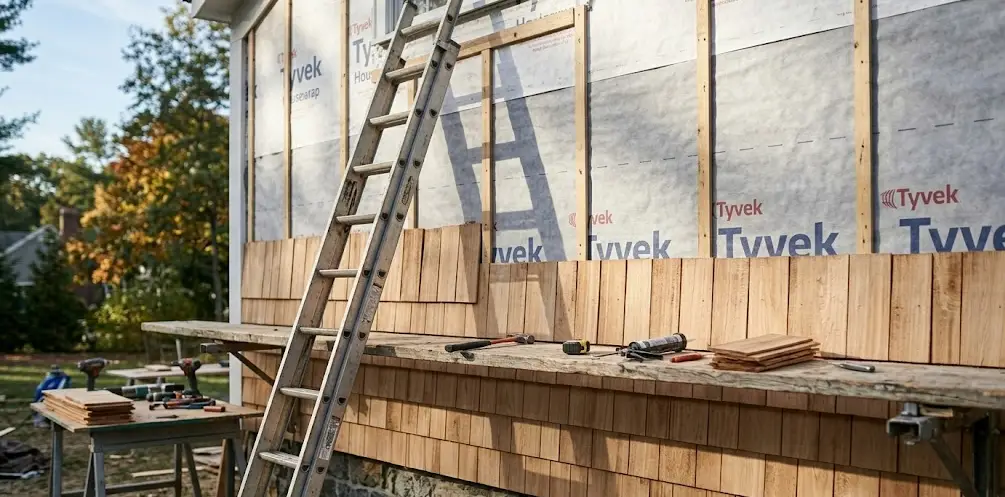
Most crews set cedar courses by snapping a chalk line and eyeballing the reveal. Our crew works off a back jig instead. It is a simple guide that registers against the course already on the wall and sets the next one at exactly the same exposure, every time, all the way up.
It is slower. That is the whole cost of it. What you get back is a wall where every shadow line is parallel and evenly spaced from the foundation to the eave. Chalk lines drift. Over twenty courses a sixteenth of an inch of drift per course becomes something your eye catches from the driveway even if you cannot name what is wrong.
It also keeps the crew honest about nail placement. When the jig sets the course, the nail lands where it should, above the exposure line and covered by the next course, rather than face-nailed through the shake where it can tear out as the wood moves.
Dave brought this up on his own when we asked what separates his crew's work. It is not something homeowners think to ask about, and it rarely turns up in a siding quote. That is exactly why it is worth telling you.
What you can see
Uniform reveal across the whole elevation. Shadow lines that stay parallel. Corners where the courses meet cleanly on both walls.
What you cannot
Fasteners placed where the next course covers them, so nothing works loose as the cedar takes on and gives up moisture through the seasons.
How should a coastal wall be built?
Siding is a rain screen, not a seal. Water gets behind it. That is expected and it is fine, as long as the wall behind can drain and dry. When it cannot, you get the rot that shows up eight years later around a window head.
So we treat the wall as an assembly, in this order:
Sheathing and the weather barrier
House wrap lapped shingle-style so every upper piece sheds over the one below. Sounds obvious. It is one of the most common things we find done backwards on tear-off.
Flashing at every opening
Head flashing over windows and doors, properly integrated with the wrap. Sill pans where they belong. Most water intrusion we open up traces to a missing or reversed flashing, not to the siding.
Drainage and drying space
A gap behind the cladding so water that gets in can run out and air can move. On cedar this is the difference between siding that lasts decades and siding that traps moisture against the sheathing.
Corrosion-resistant fasteners
Stainless in cedar, and hot-dipped or stainless elsewhere near the water. Salt air finds cheap fasteners fast, and a rusted nail is a stain on the wall and a loose board waiting to happen.
On a tear-off we photograph what we find before we cover it back up. If there is rot in the sheathing or a framing problem behind the old siding, you see it and you decide what to do about it. Nobody wants that phone call, and it is worse to find out later.
Rebuilding the deck or porch at the same time?
See deck constructionCan a section of siding be repaired instead of replaced?
Often, yes. A limb came down on one elevation. A run of shakes went soft under a gutter that has been overflowing for two winters. A corner board rotted at the base and let water in behind it. Those are repairs, and they should be priced as repairs.
What changes the answer is what sits behind the siding. Pull a few courses off and we can see whether the sheathing is dry and the wrap is intact. If it is, we patch it and you are done. If the sheathing is wet, or the flashing above it was never right, the repair turns into a wall job. New cedar over a wet wall only hides the problem for a couple of years.
Then there is matching. New cedar next to cedar that has weathered fifteen years will not match, and no stain fixes that on day one. It closes up over a few seasons. When the patch would land in the middle of the wall you see from the driveway, we will usually suggest carrying it out to a corner or a natural break so your eye reads one surface. Fiber cement is easier to match plank for plank, though a factory color from this year and one from ten years back are rarely identical.
If this is storm damage and there is an adjuster involved, Dave has sat through plenty of those calls. He walks the house, photographs what he finds, and writes it up so you have something to hand over.
Usually a repair
Damage in one area, dry sheathing behind it, and a material we can still buy. Rot that stops at the trim.
Usually not
Soft spots on more than one wall, flashing that was wrong from the start, or shakes gone brittle across a whole elevation.
Siding is only half the exterior
What people actually notice is the trim. Corner boards, window and door casing, frieze and rake, the soffit and fascia, porch columns and railings. Those are the lines that give a house its character, and they are where a cheap job gives itself away.
We work in cellular PVC and composite trim where it makes sense, because it does not rot at the ground and it holds paint, and in wood where the house calls for a moulding profile you cannot buy off the shelf. On older homes we will match an existing profile rather than substitute the closest stock item.
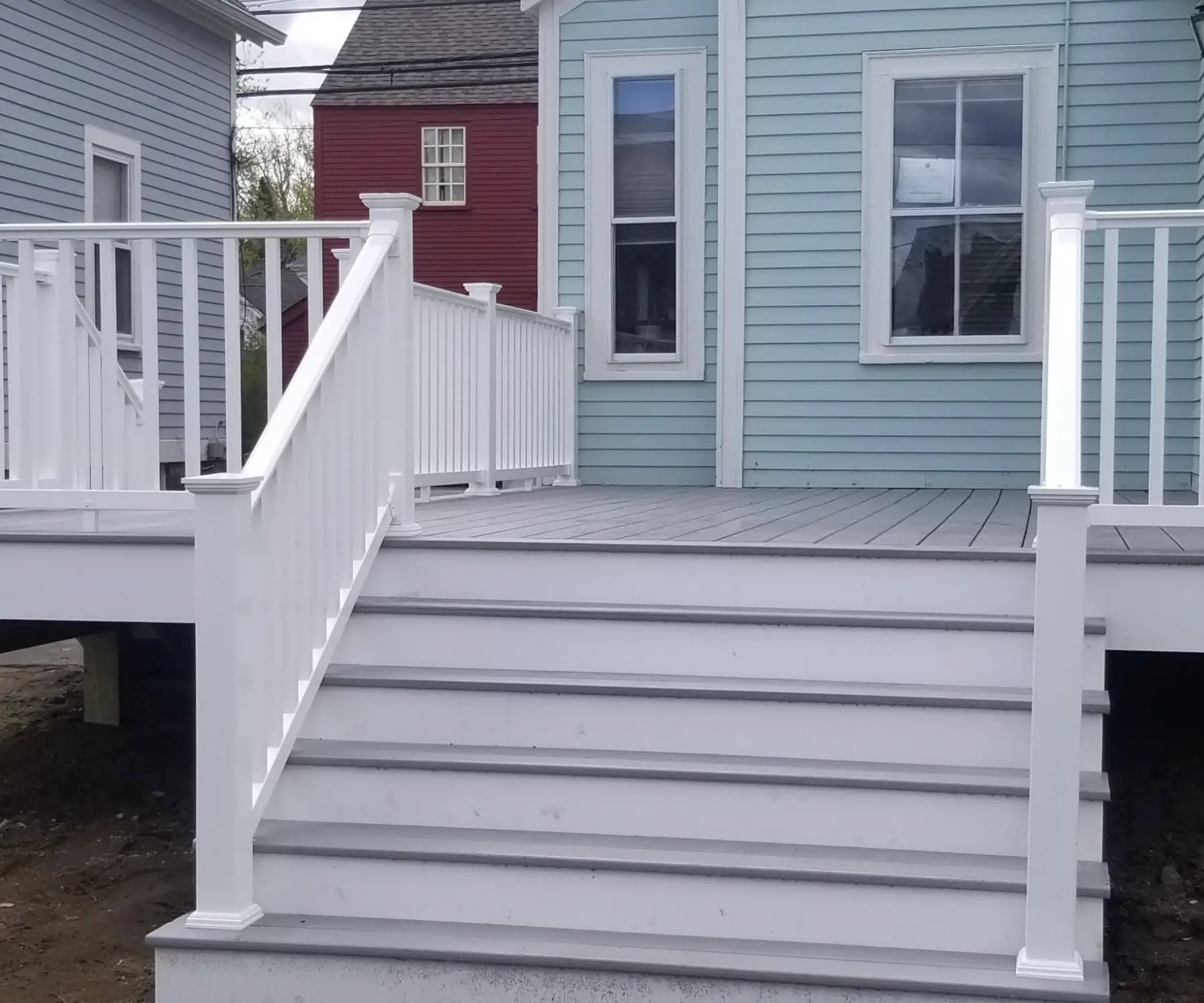
Porch rebuilds come with the territory. Columns rot from the bottom because water sits on the deck, and railings loosen because they were never fastened into anything solid. Both are carpentry problems, and carpentry is what the crew does.
Related work: home additions and whole-home renovations across the North Shore.
What is different about hiring Clarke?
Every exterior contractor will tell you they do good work. Here is the specific stuff worth asking any of them about, including us, and how we answer it.
The right-hand column describes patterns homeowners tell us about, not any particular company. Ask every contractor you talk to these seven questions and compare the answers. A good one will not mind.
Who shows up at your house?
Dave Clarke prices the job, and Dave stays on it. Alongside him is a lead carpenter running the site day to day and a ten-person exterior crew who work under the Clarke name, in Clarke shirts.
That matters more on exterior work than most people realize. Siding is one of the easiest trades to subcontract out to whoever is available that week, and it shows in the finished wall. A crew that works together learns a house. They know where the tricky corner is and who is cutting for who.
You will have Dave's number. If something changes, you hear it from him and not from a voicemail box.
Point of contact from first call to final walkthrough. Dave, every time.
Person exterior crew plus a lead carpenter, working directly for Clarke.
Years building and renovating homes across the North Shore of Massachusetts.
Service Areas for North Shore Siding Installations
Clarke Building Company is based at 51 Pleasant St. in West Newbury and works throughout Essex County and the Massachusetts North Shore.
See everything we build: Clarke's full range of services, or browse finished projects.
Common siding questions
Do you install vinyl siding?
It is not what we specialize in and it is not what we recommend. Clarke works in fiber cement and cedar because those are the materials that hold their look and their structure through coastal winters. If vinyl is genuinely the right call for your budget and your house, we will tell you that honestly, and we would rather point you to someone who does it every day than do a material we are not set up around.
Which lasts longer on the coast, cedar or fiber cement?
Both last a long time when they are installed correctly, and installation matters more than the material choice. Fiber cement asks less of you over the years and holds paint longer. Cedar needs attention, and in exchange it gives you a look and a texture that fiber cement can imitate but not match. On a historic house cedar is often the only honest answer. On a big exposed elevation that nobody wants to maintain, fiber cement usually wins.
Can you side over the existing siding?
Sometimes, and we usually advise against it. Going over the old siding hides whatever is underneath, and the whole reason to reside a house is often that something underneath needs attention. A tear-off lets us see the sheathing, correct the flashing and the weather barrier, and build the wall properly from the studs out. It costs more up front and it is the version that lasts.
What does a siding project cost?
We do not publish prices, because a square-foot number with no house attached to it will mislead you. What drives the cost is the material, the size and complexity of the elevations, how many corners and windows there are, whether there is a tear-off, and what we find behind the old siding. Dave walks the house, shows you the options and what each one costs, and you get the full picture before you commit to anything.
When is the best time of year to reside a house?
Late spring through fall is the easiest stretch, because caulk and finishes want temperature and dry weather. Work happens outside that window too, in stages, so the house is never left open. If you are planning for next season, the winter is a good time to talk, since scheduling and material lead times are both easier when nobody is in a hurry.
Are you licensed and insured?
Yes. Clarke Building Company is licensed and insured in Massachusetts and carries both liability and workers' compensation coverage. The state keeps public databases for Home Improvement Contractor registration and for Construction Supervisor Licenses, and we would encourage you to look up any contractor you are considering, us included.
Do you do the design work?
No. Clarke is a builder. If you have an architect or a designer, Dave works alongside them and builds what they draw. If you do not, he can point you toward people he has worked with on the North Shore. Keeping the two separate means somebody independent is checking the plans.
Let's walk your exterior
Dave will look at the house, tell you honestly what it needs, and lay out the options with what each one costs. No pressure and no sales pitch.